What you see here in these snowy photos is a metaphorical tip of the iceberg. During World War II, with the role of women beginning to change in society at large and also in the military, this was the very first class of women — at the University of New Hampshire, as it turns out — to undergo training similar to that of men in the Reserve Officers’ Training Corps (ROTC).
If, as the natives whisper, Daniel Webster sometimes revisits his childhood haunts when the wild winds whistle through the New Hampshire hills, he would find no more baffling sign of the U.S. at war than the sight of 650 rugged bare-legged girls drilling on a bleak, snow-covered field. These girls, students at the University of New Hampshire in Durham, are the first organized college group in the U.S. to undergo pre-graduation training like men’s ROTC which will fit them specifically for service in the WAAC, WAVES, and other auxiliaries of the armed forces. [Their training] abandons purely recreational activities in favor of military drill and calisthenics, emphasizes body building and toughening achieved through hiking, conditioning exercises, and a going-over on the rigorous, man-sized obstacle course.
Thus far the only hitch in the rigid training regimen developed when the university’s imminent Military Art Ball made it necessary to let up on all exercises for a few days because the girls were too stiff to dance.
Female students at the University of New Hampshire performed military drills in the freezing weather, 1942.
Alfred Eisenstaedt/Life Pictures/Shutterstock
Female students at the University of New Hampshire performed military drills, 1942.
Alfred Eisenstaedt/Life Pictures/Shutterstock
Female students at the University of New Hampshire performed military drills, 1942.
Alfred Eisenstaedt/Life Pictures/Shutterstock
Female students at the University of New Hampshire performed military drills, 1942.
Alfred Eisenstaedt/Life Pictures/Shutterstock
Female students at the University of New Hampshire performed military drills, 1942.
Alfred Eisenstaedt/Life Pictures/Shutterstock
Female students at the University of New Hampshire performed military drills, 1942.
Alfred Eisenstaedt/Life Pictures/Shutterstock
Female students at the University of New Hampshire performed military drills, 1942.
Alfred Eisenstaedt/Life Pictures/Shutterstock
University of New Hampshire student Shirley Sylvester (standing) straightened the shoulders of sophomore Estelle Dutton in an exercise which was designed to aid posture and strengthened pectoral muscles, 1942.
Alfred Eisenstaedt/Life Pictures/Shutterstock
Students at the University of New Hampshire during gymnasium workouts, 1942.
Alfred Eisenstaedt/Life Pictures/Shutterstock
Female students at the University of New Hampshire performed military drills in freezing weather, 1942.
Alfred Eisenstaedt/Life Pictures/Shutterstock
Students at the University of New Hampshire ice skated as part of an intensive, wartime physical education program, 1942.
Alfred Eisenstaedt/Life Pictures/Shutterstock
Female students at the University of New Hampshire fencing in gymnasium, 1942.
Alfred Eisenstaedt/Life Pictures/Shutterstock
Students at the University of New Hampshire exercised on the gymnasium floor, 1942.
The Beatles began by ceaselessly playing gigs in Liverpool and overseas in Hamburg and building enormous buzz before finally releasing their first single, “Love Me Do,” on Oct. 5, 1962. That’s when everything changed. Granted, “Love Me Do” was hardly the most inspired tune ever to spring from the stunningly fertile minds of Lennon and McCartney. But it was the band’s first-ever single, and thus a pivotal moment in the history of rock and roll.
Beyond the influence their music had on everyone from Dylan and the Beach Boys to Hendrix and the Stones, the band also sparked the era-defining phenomenon known as Beatlemania—the seemingly spontaneous unleashing of (largely) female adoration and erotic energy that certainly had its pop-culture precedents, but remains notable for the sheer scale of the hysteria that greeted the Beatles everywhere. In fact, one of the reasons the band stopped touring so early in its career, and retreated to the studio for the last four years of its remarkably short life, is that the sound erupting from their frantic fans made concerts an exercise in futility: the lads literally could not hear themselves play.
Here, LIFE.com presents a series of photographs—none of which ran in LIFE—made by Stan Wayman at the Beatles’ first concert in America, a performance at the Washington Coliseum on Feb. 11, 1964, two days after their historic appearance on the Ed Sullivan Show in New York. It was a surprisingly intimate affair, with the band playing on a small stage literally feet from the fans—albeit behind a loose phalanx of cops.
The pictures in the gallery, however, don’t focus on the Fab Four. Instead, they’re portraits, made in the moment, of young women who are alternately transfixed, driven to tears and virtually unhinged with excitement. Here are the faces of the first Americans to see the Beatles in concert. Here is Beatlemania looked and felt like as it landed in the United States.
Fans at the first Beatles concert in America, Washington, DC, Feb. 11, 1964.
Stan Wayman/Life Pictures/Shutterstock
Fans at the first Beatles concert in America, Washington, DC, Feb. 11, 1964.
Stan Wayman/Life Pictures/Shutterstock
Fans at the first Beatles concert in America, Washington, DC, Feb. 11, 1964.
Stan Wayman/Life Pictures/Shutterstock
Fans at the first Beatles concert in America, Washington, DC, Feb. 11, 1964.
Stan Wayman/Life Pictures/Shutterstock
Fans at the first Beatles concert in America, Washington, DC, Feb. 11, 1964.
Stan Wayman/Life Pictures/Shutterstock
Fans at the first Beatles concert in America, Washington, DC, Feb. 11, 1964.
Stan Wayman/Life Pictures/Shutterstock
Fans at the first Beatles concert in America, Washington, DC, Feb. 11, 1964.
Stan Wayman/Life Pictures/Shutterstock
Fans at the first Beatles concert in America, Washington, DC, Feb. 11, 1964.
Stan Wayman/Life Pictures/Shutterstock
Fans at the first Beatles concert in America, Washington, DC, Feb. 11, 1964.
Stan Wayman/Life Pictures/Shutterstock
Fans at the first Beatles concert in America, Washington, DC, Feb. 11, 1964.
Stan Wayman/Life Pictures/Shutterstock
Fans at the first Beatles concert in America, Washington, DC, Feb. 11, 1964.
Stan Wayman/Life Pictures/Shutterstock
Fans at the first Beatles concert in America, Washington, DC, Feb. 11, 1964.
Stan Wayman/Life Pictures/Shutterstock
Fans at the first Beatles concert in America, Washington, DC, Feb. 11, 1964.
Stan Wayman/Life Pictures/Shutterstock
Fans at the first Beatles concert in America, Washington, DC, Feb. 11, 1964.
Stan Wayman/Life Pictures/Shutterstock
Fans at the first Beatles concert in America, Washington, DC, Feb. 11, 1964.
Stan Wayman/Life Pictures/Shutterstock
Fans at the first Beatles concert in America, Washington, DC, Feb. 11, 1964.
Stan Wayman/Life Pictures/Shutterstock
Fans at the first Beatles concert in America, Washington, DC, Feb. 11, 1964.
Stan Wayman/Life Pictures/Shutterstock
Fans at the first Beatles concert in America, Washington, DC, Feb. 11, 1964.
Stan Wayman/Life Pictures/Shutterstock
Fans at the first Beatles concert in America, Washington, DC, Feb. 11, 1964.
Stan Wayman/ Life Pictures/Shutterstock
Fans at the first Beatles concert in America, Washington, DC, Feb. 11, 1964.
Stan Wayman/Life Pictures/Shutterstock
Fans at the first Beatles concert in America, Washington, DC, Feb. 11, 1964.
Stan Wayman/Life Pictures/Shutterstock
Fans at the first Beatles concert in America, Washington, DC, Feb. 11, 1964.
Stan Wayman/Life Pictures/Shutterstock
Fans at the first Beatles concert in America, Washington, DC, Feb. 11, 1964.
Stan Wayman/Life Pictures/Shutterstock
Fans at the first Beatles concert in America, Washington, DC, Feb. 11, 1964.
They had fame, reams of money and fans willing to do wild, unmentionable things just to breathe the same air but in its September 24, 1971 issue, LIFE magazine illustrated a different side of the lives of rock stars. Like other mere mortals, they often came from humble backgrounds, with moms and dads who bragged about them, fussed over them, called them on their nonsense and worried about them every single day.
Assigned to take portraits of the artists at home with their sweetly square folks, photographer John Olson traveled from the suburbs of London to Brooklyn to the Bay Area, capturing in his work the love that bridged any cultural and generational divides that existed between his subjects.
Here, LIFE.com brings back Olson’s nostalgia-sparking photos—Marvel at the decor! Gaze in wonder at the shag carpets and bell-bottoms!—and shares his memories of hanging out with pop culture icons of the Sixties and Seventies, as well as their mums and their dads.
John Olson on Frank Zappa: “Everyone had told me that Frank Zappa was going to be really difficult, and he couldn’t have been more professional,” Olson told LIFE.com.
Zappa on His Parents: “My father has ambitions to be an actor,” Frank told LIFE. “He secretly wants to be on TV.”
Zappa’s Mom on Zappa: “The thing that makes me mad about Frank is that his hair is curlier than mine and blacker.”
Grace Slick: Grace Slick’s mom Virginia Wing, wrote LIFE, was a “soft-spoken suburban matron” pretty much the opposite of her wild child. “Grace and I have different sets of moral values,” Mrs. Wing told LIFE, “but she’s her own person, and we understand each other.”
Elton John: In 1970, Elton John was just three albums into his prolific career, and still had countless hits— “Rocket Man,” “Daniel,” “Bennie and the Jets” and “Candle in the Wind” among them—in his future. (As well as the 2019 biopic, Rocketman.) “When he was four years old,” his mother said of her prodigiously talented son, “we used to put him to bed in the day and get him up to play at night for parties.”
Ginger Baker: The world knew him as Ginger, on account of his red hair, but his mother christened him Peter, and to her he was always “my Pete.” As she told LIFE magazine: “He would bring people over and they would say, ‘You realize your son is brilliant,’ and I’d say, ‘Is he? I wish he was a bit more brilliant at keeping his room tidy.'” Ginger died in late 2019.
John Olson on Ginger Baker: “I had worked with lots of these musicians before and on the first go-round some of them had been really difficult. But when they were with their parents, they were totally different people. Baker, who had been terribly obnoxious before, acted like a grown-up. I don’t think it had anything to do with respect for me, so it must have been the parents.”
Joe Cocker: Facial contortions, flailing arms, gallons of sweat: the blues singer poured all that and more into his passionate performances. But off stage, LIFE observed, “he is cool and withdrawn a temperamental mixture of Harold Cocker, his civil servant father who preferred gardening to posing with his famous son, and his outgoing, chatty mother.”
David Crosby: With his parents divorced, the “Crosby” of Crosby, Stills, Nash & Young posed with his father Floyd, an Oscar-winning cinematographer, in the Ojai, Calif., home Floyd shared with his second wife in 1970. “In the last few years we’ve become good friends,” David told LIFE magazine. “What I like best about him is that he seems to feel no need for me to be like him, so we’re not offended by each other’s differences. Like he knows I get high. He doesn’t do it and he doesn’t approve of it, but he doesn’t inflict his values on me.”
Jackson 5: Unlike the other stars featured in LIFE’s story, the Jackson brothers Michael, Marlon, Tito, Jermaine and Jackie experienced fame as kids, and still lived with their parents (father/manager Joe and mother Katherine). At the time of LIFE’s shoot, they were the hottest act in pop, skyrocketing in 1970 with “ABC” and “I’ll Be There,” and had just moved into an expansive new house.
“It was very controlled,” Olson says of the photo shoot that resulted in the September, 24, 1971 LIFE cover. “As I remember, they followed my requests to a T, and were incredibly polite. The dad was pretty stern.” Indeed, Joe who had been a crane operator in Gary, Indiana, just three years before hinted at the relentless drive toward fame about which Michael would later voice such ambivalence. “It wasn’t hard to know they could go on to be professionals,” Joe told LIFE of his young sons. “They won practically all the talent shows and I wasn’t surprised when they did make it.”
Donovan: His parents’ love of Scottish and English folk music inspired Donovan, the singer/songwriter behind such hits as “Season of the Witch” and “Mellow Yellow.” But by the time of his photo session with Olson, Donovan’s fruitful partnership with record producer Mickie Most had soured, and his career was in decline. Perhaps as a result, Donovan was the only musician Olson photographed who was left out of the story that LIFE eventually published.
David Crosby with his father Floyd, together in the father’s house, 1970.
John Olson/Life Picture Collection/Shutterstock
Frank Zappa in his Los Angeles home with his dad, Francis, his mom, Rosemarie, and his cat in 1970.
John Olson/Life Pictures/Shutterstock
Frank Zappa with his dad, Francis, and his mom, Rosemarie, in 1970.
John Olson/Life Pictures/Shutterstock
The Jefferson Airplane’s Grace Slick posed with her mother, Virginia Wing, in the living room of the home where she grew up in Palo Alto, California. “We raced out there because she was nine months pregnant,” remembered Olson, the photographer. “And the rest of the story took so long to complete, her daughter was a year old when it finally ran.”
John Olson/Life Pictures/Shutterstock
In a second shoot with Grace Slink, the new mom dangled her daughter China by the feet in 1971
John Olson/Life Pictures/Shutterstock
Grace Slick stepped outside with her mom and little China in 1971.
John Olson/Life Pictures/Shutterstock
Eric Clapton with grandmother Rose Clapp in 1970 in Surrey, England.
John Olson/Life Pictures/Shutterstock
The former Reggie Dwight, later known as Elton John, laughed with his mom Sheila Fairebrother and Sheila’s husband Fred (whom Elton affectionately called “Derf,” Fred spelled backwards) in their suburban London apartment in 1970.
John Olson/Life Pictures/Shutterstock
David Crosby with his father, 1970.
John Olson/Life Pictures/Shutterstock
Richie Havens with his parents in Brooklyn, 1970. The musician who opened the show at Woodstock grew up with his folks, Richard and Mildred, in Bedford-Stuyvesant, Brooklyn, but he bought them this home in nearby East Flatbush when his music career took off. The Havenses had nine kids and, as Mrs. Havens told LIFE, “Richie is the only one who’s really moved away. I can’t get rid of most of them.”
John Olson/Life Pictures/Shutterstock
Ginger Baker, the Cream and Blind Faith drummer, flashed a smile with his mother Ruby Streatfield inside her rowhouse in Bexley, outside London, in 1970.
John Olson/Life Pictures/Shutterstock
Ginger Baker and his mum, 1970.
John Olson/Life Pictures/Shutterstock
The Jackson 5 posing with their parents in Encino, Calif., in 1970.
John Olson/Life Pictures/Shutterstock
LIFE photographer John Olson set up to shoot the Jackson 5 in their backyard in 1970.
John Olson/Life Pictures/Shutterstock
With their parents standing by, 13-year-old dynamo Michael (front left) and his brothers Jackie, Marlon, Tito and Jermaine straddled their motorbikes by the pool, 1970.
John Olson/Life Pictures/Shutterstock
Donovan and his parents, Donald and Winifred Leitch, England in 1970.
John Olson/Life Pictures/Shutterstock
Joe Cocker with his mother, 1970, from a series John Olson shot on rock stars and their parents.
Sports fans are notoriously contrary, but all would have to agree that “the Super Bowl” is a far better name for pro football’s ultimate contest than “the AFL-NFL World Championship Game,” which is exactly what it was called for the first two years it was played, in 1967 and 1968.
A sign that this championship wasn’t the big deal then that it is today: the game did not sell out the Los Angeles Coliseum. It is the only Super Bowl not to fill all its seats. The matchup was not expected to be competitive, and it wasn’t, especially. Vince Lombardi’s Green Bay Packers handily beat the Kansas City Chiefs 35-10, with quarterback Bart Starr being named the game’s Most Valuable Player. Starr would earn that honor again in Super Bowl II, his Packers beat the Raiders, 33-14 in Miami.
In fact, the real historical importance of these first two lopsided games between the NFL and AFL champs is that it helps explain why what happened in Super Bowl III was such a big deal. After those first two blowouts of the AFL teams, it was a true shocker when Joe Namath and his New York Jets scored that first win for the AFL, and helped pave the road to the NFL-AFL merger.
Here, LIFE.com presents a series of photos, none of which ran in LIFE magazine, made by Bill Ray and Art Rickerby before, during and after that inaugural game.
Almost everything about the Super Bowl has changed drastically in the long years since Green Bay and Kansas City took the field. That’s part of the appeal of the photos. They’re like baby pictures of a game that is about to grow up—way, way up.
The Kansas City Chiefs waited to take the field against the Packers prior to the start of Super Bowl I, Los Angeles, 1967.
Bill Ray/Life Pictures/Shutterstock
Kansas City’s Fletcher Smith, with the Green Bay Packers massed behind him, prior to the start of Super Bowl I, Los Angeles, 1967.
Bill Ray/Life Pictures/Shutterstock
Green Bay offensive lineman Jerry Kramer in Super Bowl I, 1967.
Art Rickerby/Life Pictures/Shutterstock
Super Bowl I, 1967.
Art RickerbyLife Pictures/Shutterstock
Green Bay’s Elijah Pitts eluded Kansas City defenders, Super Bowl I, 1967.
Art Ricker/Life Pictures/Shutterstock
Chiefs linebacker E. J. Holub, Super Bowl I, 1967.
Bill Ray/Life Pictures/Shutterstock
Packers head coach Vince Lombardi, Super Bowl I, 1967.
Bill Ray/Life Pictures/Shutterstock
Green Bay wide receiver Max McGee, Super Bowl I, 1967, was the game’s surprise star, with seven receptions for 138 yards and two touchdowns.
Art Rickerby/Life Pictures/Shutterstock
Football’s escalation in the American consciousness took a great leap forward in 1967, when Bart Starr led the Green Bay Packers to a win over the Kansas City Chiefs at the Los Angeles Coliseum in the first Super Bowl.
Elijah Pitts (No. 22) ran the Packers’ signature play, the power sweep, Super Bowl I, 1967.
Art Rickerby/Life Pictures/Shutterstock
Tight end Reggie Carolan in the Chiefs’ locker room, Super Bowl I, 1967.
Bill Ray/Life Pictures/Shutterstock
Kansas City defensive lineman Jerry Mays prior to Super Bowl I, 1967.
Bill Ray/Life Pictures/Shutterstock
Quarterback Len Dawson in the Chiefs’ locker room, Super Bowl I, 1967.
Bill Ray/Life Pictures/Shutterstock
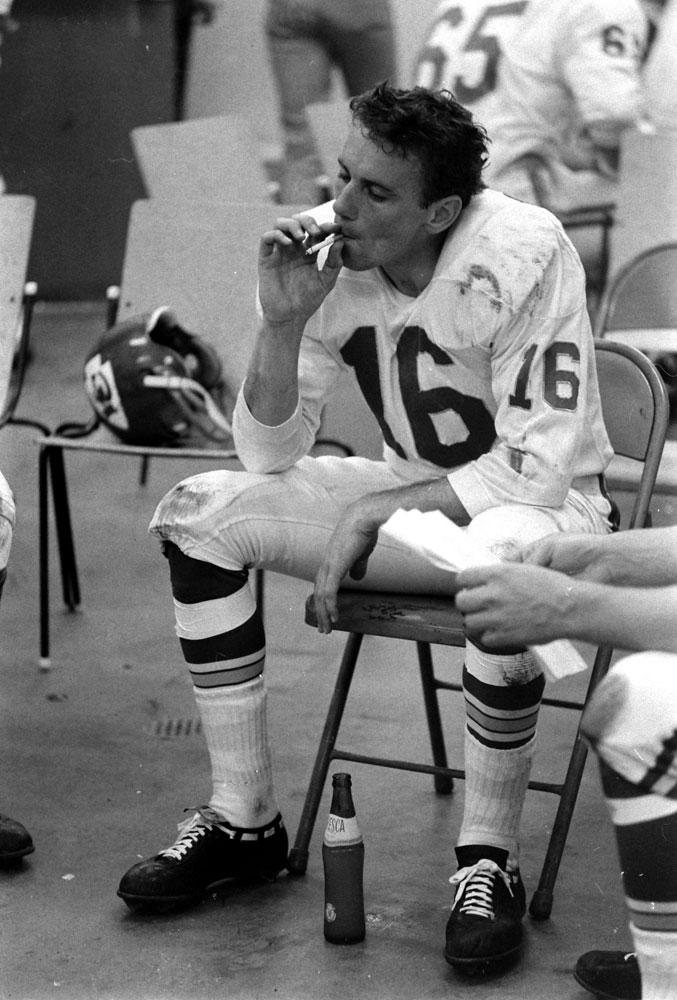
Kansas City sideline, Super Bowl I, 1967.
Bill Ray/Life Pictures/Shutterstock
Green Bay receiver Carroll Dale was hit by the Chiefs’ Willie Mitchell, Super Bowl I, 1967.
Art Rickerby/Life Pictures/Shutterstock
Green Bay running back Jim Taylor (No. 31), Super Bowl I, 1967.
Art Rickerby/Life Pictures/Shutterstock
Kansas City’s Fred Williamson was carried off the field after breaking his arm, Super Bowl I, 1967.
Bill Ray/Life Pictures/Shutterstock
Kansas City head coach Hank Stram, Super Bowl I, 1967.
Bill Ray/Life Pictures/Shutterstock
Paul Hornung (No. 5), a future Hall of Famer, did not play in the game due to injury, Super Bowl I, 1967.
Art Rickerby/Life Pictures/Shutterstock
Jim Taylor was tackled by the Chiefs’ Sherrill Headrick, Super Bowl I, 1967.
Art Rickerby/Life Pictures/Shutterstock
Jim Taylor (No. 31) in Super Bowl I.
Art Rickerby/Life Pictures/Shutterstock
Jim Taylor, Super Bowl I, 1967.
Art Rickerby—Time & Life Pictures/Shutterstock
On the Kansas City sideline, Super Bowl I, 1967.
Bill Ray/Life Pictures/Shutterstock
Fred Williamson was led from the field at the end of the first Super Bowl, 1967. Williamson broke his arm during the game.
Bill Ray/Life Pictures/Shutterstock
Jerry Mays and other Kansas City Chiefs, Super Bowl I, 1967.
Bill Ray/Life Pictures/Shutterstock
The Packers’ Herb Adderley and Kansas City’s tight end Fred Arbanas headed to the lockers after Green Bay’s 35-10 victory in Super Bowl I, Los Angeles, 1967.
The only way to tell most New Year’s Eves apart is by the numbers that appear on the novelty hats and glasses. But December 31, 1941 was different. This was not long after the December 7 attack on Pearl Harbor, and America was finally, officially engaged in the world war that had begun 15 months before, when Germany invaded Poland. No one knew how long the war would last—but no one was betting it would be over soon.
And yet the party went on—in many ways the same, but it other ways clearly different. Here, LIFE.com remembers a wartime New Year’s Eve in a virtually unrecognizable New York City.
Times Square at midnight on New Year’s Eve, as 1941 became 1942.
John Phillips The LIFE Picture Collection/Shutterstock
Military police in Times Square on New Year’s Eve, as 1941 turned to 1942.
Gordon Coster The LIFE Picture Collection/Shutterstock
Times Square in New York City on New Year’s Eve, as 1941 turned to 1942.
Gordon Coster The LIFE Picture Collection/Shutterstock
Times Square in New York City on New Year’s Eve, as 1941 turned to 1942.
Gordon Coster The LIFE Picture Collection/Shutterstock
New York City on New Year’s Eve, as 1941 turned to 1942.
Gordon Coster The LIFE Picture Collection/Shutterstock
Partiers in New York City on New Year’s Eve, as 1941 turned to 1942.
Gordon Coster The LIFE Picture Collection/Shutterstock
Partiers in New York City on New Year’s Eve, as 1941 turned to 1942.
Gordon Coster The LIFE Picture Collection/Shutterstock
Partiers in New York City on New Year’s Eve, as 1941 turned to 1942.
Gordon Coster The LIFE Picture Collection/Shutterstock
Partiers in New York City on New Year’s Eve, as 1941 turned to 1942.
Gordon Coster The LIFE Picture Collection/Shutterstock
Partiers in New York City on New Year’s Eve, as 1941 turned to 1942.
Gordon Coster The LIFE Picture Collection/Shutterstock
Times Square in New York City on New Year’s Eve, as 1941 turned to 1942.
Gordon Coster The LIFE Picture Collection/Shutterstock
In August 1972, LIFE magazine published an intimate and, for the time, remarkably even-handed article on the mounting problems associated with street gangs in New York and other cities around the country. The piece focused on one gang in particular, the Reapers in the South Bronx, and featured a series of powerful color pictures by a young photographer named John Shearer.
Shearer was only the second African-American staff photographer ever hired by LIFE—after Shearer’s mentor and friend, the great Gordon Parks—but even he had trouble penetrating the gang’s wall of suspicion.
“I visited the neighborhood five or six times, without my camera,” Shearer recently told LIFE.com, “just so I could get a feel for that part of the South Bronx. A few times I was approached by Reapers asking me what I was dong there, but largely I was left alone.”
Then, on one fortuitous early morning after a late night in the neighborhood, an exhausted Shearer was sitting outside a bodega drinking a cup of coffee when a Reaper literally tripped over his legs. It turned out the young man was none other than Eddie Cuevas, the charismatic president of the gang.
Shearer and Cuevas got to talking, and when Cuevas learned that Shearer was not only a genuine photojournalist with an impressive list of assignments already under his belt, but that he was also the son of Ted Shearer, the groundbreaking visual artist and creator of the long-running comic strip Quincy, it was a done deal. The next day, Cuevas informed Shearer that he could begin shooting the Reapers lives in earnest.
“Eddie fancied himself something of an artist,” Shearer recalled. “He’d designed the Reapers’ colors, and the fact that my dad was the man behind a comic strip that he read every day provided me with my ticket into his world.”
For its part, months later LIFE wrote of that world in its Aug. 25, 1972, issue:
Eddie Cuevas, 20 years old, is the tough president (“Prez) of a tough 200-member Bronx street gang called the Reapers. He has been a Reaper since he was barely into his teens. The Reapers were then declining, losing strength steadily to the more glamorous incoming drug culture. But the street gangs have come back in New York and other major cities. They are larger and more dangerous than before, but now drugs are out. “I saw what they did — lots of guys ripped off, string out or dead,” says Eddie.
In the Bronx alone there are over 100 street gangs … Gangs still argue perpetually, fight often and even occasionally kill over such matters as prestige and “colors,” the sleeveless denim jackets bearing the gang’s name and symbol … “Gangs like the Reapers are good and bad,” says a Bronx patrolman on he beat. “One night they’ll spend two hours helping us look for a rapist, the next they’re out to beat up some civilians.”
The article ended with a mention that Eddie had been arrested on a charge of attempted homicide. He was in Riker’s Island jail, awaiting trial. He eventually beat the charges, and even found some work for a time painting sets and doing other part-time work for theater companies after Shearer made a few inquiries in an effort to Cuevas escape the gang life.
How long Eddie’s “straight” life lasted, though, remains a mystery. Shearer lost touch with him, and with all the other Reapers, not long after the feature ran in LIFE a not-unusual occurrence that, Shearer admitted, was emblematic of one of the toughest parts of the job.
“You’d work for weeks on an assignment,” he told LIFE.com, “and sometimes—not always, but sometimes—the relationships and even the friendships you forged during that time could be pretty intense. But maintaining those relationships was close to impossible. It simply wasn’t like today, with email and Facebook and all the other ways people have of keeping in touch with each other, all over the world. You’d be off on another assignment, and then another, and then another, and there’s just no way that we could have stayed in touch with everyone we came in contact with and stayed on top of what they were doing, or even if they were dead or alive.”
In recent years, some of the Reapers from those days have gotten in touch with Shearer, finding him via the Internet and seeing if he might be interested in meeting again after all this time. In fact, not long ago he was invited to a reunion, of sorts, in the Bronx but it turned out that the weather that day was hellish and it was impossible for him to travel down to see his old (some of them now very old) acquaintances from where he now makes his home in a small town north of New York.
“I really would have liked to have been there,” he said, “but it just didn’t happen that day. Maybe some other time.” The way Shearer says it, that phrase maybe some other time sounds different than when other people say it.
It sounds like he means it. It sounds like he wants it to be true.
John Shearer has been a photographer, writer, director, lecturer and professor. At 17 years old, he was one of the youngest staff photographers at a major publication when he was hired by LOOK magazine, where he covered civil rights and the race riots of the 1960s. He was hired by LIFE in 1968, where he was the second African-American staff photographer in the magazine’s history. Shearer has won 175 national photography awards. His work has been exhibited at the Metropolitan Museum of Art, MOMA and the Whitney Museum.
Reapers president Eddie Cuevas met with gang members, South Bronx, 1972.
John Shearer/Life Pictures/Shutterstock
On a Bronx street were names important to the Reapers: Eddie, his girl friend Yvette, Con and Mr. Kool, the war lord and vice-president.
John Shearer/Life Pictures/Shutterstock
Eddie often complained about being hassled by police, but he got along well with the cop on the beat, and talked about wanting to become a policeman himself: “I’d rap to the fellows and take care of my people.”
John Shearer/Life Pictures/Shutterstock
Reapers gang members cleaned up their South Bronx neighborhood, 1972.
John Shearer/Life Pictures/Shutterstock
With Javelins, nearby allies, Eddie discussed plans to clean up neighborhood.
John Shearer/Life Pictures/Shutterstock
Flanked by his warlord (wearing a hat), Eddie warned the president of a rival gang to leave Reaper members alone.
John Shearer/Life Pictures/Shutterstock
In a city youth agency office that sometimes gave him funds, Eddie argued for money for trips out of the city: “I want my boys to see what the world’s about.”
John Shearer/Life Pictures/Shutterstock
A peace treaty among the gangs was violated by rivals. Under pressure to retaliate, Eddie instead went before a night meeting and asked for patience.
John Shearer/Life Pictures/Shutterstock
The Reapers street gang, New York, 1972.
John Shearer/Life Pictures/Shutterstock
In an apartment building corridor, members of the Reapers administered their own swift and brutal justice to a junkie accused of having stolen a Reaper’s car.
John Shearer/Life Pictures/Shutterstock
In an apartment building corridor, members of the Reapers administered their own swift and brutal justice to a junkie accused of having stolen a Reaper’s car.
John Shearer/Life Pictures/Shutterstock
Eddie and his fellow Reapers paid their respects to ‘Chino’ Rosa, a member of a neighboring gang who was knifed to death. Friends of Chino’s said he was held up and murdered by a junkie, but a grand jury decided that Chino’s assailant had been acting in self-defense. The Reapers donated a week’s dues to the bereaved family.
John Shearer/Life Pictures/Shutterstock
Eddie’s mother maintained a shrine to her husband in the four years since his death.
John Shearer/Life Pictures/Shutterstock
Reapers president Eddie Cuevas and his mother in their South Bronx apartment, 1972.
John Shearer/Life Pictures/Shutterstock
Eddie and Yvette had been going steady for four years: “When we get married,” he said with pride, “she’s going to wear a white dress.”
John Shearer/Life Pictures/Shutterstock
Eddie Cuevas, president of the Reapers street gang, peered out a window in the South Bronx, 1972.
John Shearer/Life Pictures/Shutterstock
Eddie Cuevas, president of the Reapers street gang, with his girlfriend Yvette, South Bronx, 1972.